Roundabout rules in Spain: who has priority, which way you go and where it gets tricky
Reviewed on 11 October 2026 · sources: BOE (Reglamento General de Circulación, Ley de Tráfico)
Short answer. In Spain, vehicles already on the roundabout have priority over vehicles that want to enter. You go round with the centre of the roundabout on your left, so traffic circulates anticlockwise and always reaches your entry from the left. Signs, traffic lights and police officers override the general rule. This comes from article 57.1.c of the Reglamento General de Circulación (the general traffic regulation) and article 43.2.
If you learned to drive in the UK, Ireland, Australia or Japan, note that the direction is the opposite of what you know. In the USA and most of continental Europe it is the same as here.
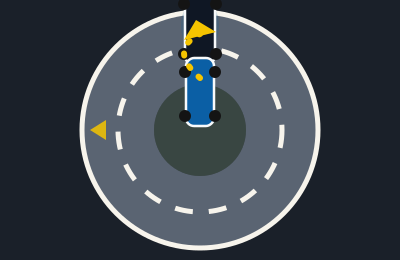
The rule in three parts
- Direction. In squares, roundabouts and junctions where roads meet, vehicles go round leaving the centre on their left (art. 43.2).
- Priority. When no sign says otherwise, drivers already inside the circular lane have priority over those who want to get in (art. 57.1.c). Most entries have a give-way sign (R-1) as well, which makes you give way to traffic on the road you are joining.
- Signals come first. Priority at junctions follows the signs that regulate it (art. 56.1). A traffic light at the entrance, or an officer directing traffic, comes before the ring rule.
The legal definition of a roundabout (glorieta) is a junction whose arms connect through a ring with rotary traffic around a central island. The so-called split roundabouts, where two opposite arms connect straight across the island, are not roundabouts in law, so the ring rule does not apply there (Ley de Tráfico, annex I, definition 63). Follow the signs and the normal junction rules.
Who gives way to whom
| Situation | Who gives way |
|---|---|
| You want to enter the roundabout | You, to vehicles already on the ring |
| You are on the ring | Nobody, unless a sign or signal says so |
| You change lane inside the ring | You, to the vehicle in the lane you are moving into (art. 74.2) |
| A pedestrian is on a marked crossing at an entry or exit | You, the driver (art. 65.1.a) |
Overtaking inside a roundabout is not banned: the general ban on overtaking at junctions expressly excepts roundabouts (art. 87.1.c).
A worked example: two lanes and an exit
You enter from the south on a two-lane roundabout and stay in the inner lane because you plan to go straight on. At the last moment you decide to take the first exit, on your right, but a car is travelling in the outer lane.
- The car is already in the lane you want to move into. Article 74.2 says a lateral move that changes lane must respect the priority of the driver in that lane. Being on the ring for longer does not change that.
- You signal right, which is the warning for a lateral move (art. 109), and let the car pass.
- You exit behind it, or go round once more. Cutting across is a priority offence even though you are inside the ring.
The trap. "Inside the ring" does not mean "priority over everybody". The ring rule protects drivers who are circulating against drivers who are entering. It does not give you priority when you change lane, or when you leave across an occupied lane. And giving way is not the same as stopping: with a clear ring you do not need to stop, but you must stop completely when it is necessary (art. 56.5), so look first and enter second.
If you break the rule
Failing to respect the rules on priority is a serious offence: a 200 euro fine (Ley de Tráfico, art. 76.c and art. 80.1) and the loss of 4 points (annex II, item 10).
Keep going
- The topic in the syllabus: junctions and right of way.
- The matching signs, in Spanish: R-1 give way and P-4 roundabout ahead.
- The next rule: priority at junctions without roundabouts.
- Practise it: today's free 30-question DGT exam, available in English.
Reviewed against the consolidated BOE text on 11 October 2026. DrivingLingo is independent and is not endorsed by the DGT. This page is not legal advice.