Speed limits in Spain: motorway, main road, town and with a trailer
Reviewed on 11 October 2026 · sources: BOE (Reglamento General de Circulación, Ley de Tráfico, Código Penal)
Short answer. With no sign, the default limit is set by the road and by the vehicle. A car or motorcycle may do 120 km/h on a motorway (autopista) or dual carriageway (autovía) and 90 km/h on a conventional road. In towns it is 20, 30 or 50 km/h depending on the street. A car towing a trailer or caravan drops to 90 on a motorway and 80 on a conventional road. A speed-limit sign overrides the default (art. 52.1.a). The figures are in articles 48 and 50 of the Reglamento General de Circulación, the general traffic regulation.
All limits are in km/h. Spain does not use mph.
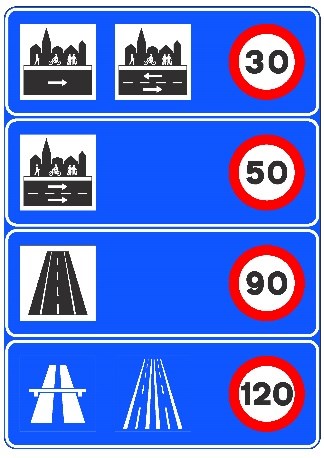
Outside built-up areas
Article 48.1.a splits vehicles into three groups:
| Vehicle | Motorway and dual carriageway | Conventional road |
|---|---|---|
| Cars, motorcycles, motorhomes up to 3,500 kg, pick-ups | 120 | 90 |
| Lorries, vans, motorhomes over 3,500 kg, articulated vehicles, cars with a trailer and the rest | 90 | 80 |
| Buses, car-derived vehicles and adaptable mixed vehicles | 100 | 90 |
Other figures from the same article: 45 km/h for cycles, mopeds and light quadricycles (cyclists may exceed it where the road allows), 30 km/h on unpaved roads, and 70 km/h for three-wheelers and quadricycles. On a conventional road with a physical barrier between the two directions, the road owner may set 100 km/h for cars, motorcycles and motorhomes up to 3,500 kg. School transport and dangerous-goods vehicles take 10 km/h off the limit for their group. A bus carrying standing passengers, or one without seat belts, is limited to 80 km/h on any road outside built-up areas, under the wording introduced by Royal Decree 518/2026, in force since 1 October 2026.
In built-up areas
| Type of street | Default limit |
|---|---|
| Single surface for road and pavement | 20 km/h |
| One lane in each direction | 30 km/h |
| Two or more lanes in each direction | 50 km/h |
| Through road (travesía), any vehicle | 50 km/h |
| Motorway or dual carriageway inside a built-up area | 80 km/h |
Lanes reserved for certain users or for public transport are not counted when you count lanes. The town hall can lower these limits with specific signs and, on one-lane streets, raise them to 50 (art. 50). A travesía is the stretch of an inter-urban road that runs through a town; its limit is 50 km/h for every type of vehicle.
Minimum speed
You may not drive below 60 km/h on a motorway or dual carriageway, nor below half the default limit for your vehicle on other roads, unless something justifies it, such as traffic or road conditions (art. 49).
A worked example: the caravan on the dual carriageway
You drive a car that, alone, may do 120 km/h on a dual carriageway. You hitch up a caravan.
- A car pulling a trailer belongs to the "cars with a trailer" row, so it moves to the second line of the table.
- On a dual carriageway your limit is now 90 km/h, not 120.
- On a conventional road it falls from 90 to 80 km/h.
- If a speed-limit sign (R-301) shows a lower figure on that stretch, that figure prevails over the default.
The trap. The limit depends on the vehicle, not only on the road. Learning "120 on the motorway, 90 on other roads" misses the separate column for lorries, motorhomes over 3,500 kg, cars with trailers and buses, and the 80 km/h cap for a bus with standing passengers or no seat belts.
What happens if you exceed it
Speeding caught by a speed camera is fined under annex IV of the Ley de Tráfico, according to the limit of the road and the speed measured. Examples from that table:
| Limit of the road | 100 EUR, no points | 300 EUR, 2 points | 400 EUR, 4 points | 500 EUR, 6 points | 600 EUR, 6 points |
|---|---|---|---|---|---|
| 50 km/h | 51 to 70 | 71 to 80 | 81 to 90 | 91 to 100 | 101 or more |
| 90 km/h | 91 to 120 | 121 to 140 | 141 to 150 | 151 to 160 | 161 or more |
| 120 km/h | 121 to 150 | 151 to 170 | 171 to 180 | 181 to 190 | 191 or more |
Driving more than 60 km/h above the limit in a town, or more than 80 km/h above it on an inter-urban road, is a crime and not just an offence (Código Penal, art. 379.1). There is no extra margin while you overtake: the limit still applies, as the rules in overtaking cyclists show.
Keep going
- The topic in the syllabus: speed.
- The sign: R-301 maximum speed (in Spanish).
- Related rules: drink-driving limits.
- Practise: today's free 30-question DGT exam, available in English.
Reviewed against the consolidated BOE text on 11 October 2026. DrivingLingo is independent and is not endorsed by the DGT. This page is not legal advice.