Overtaking a cyclist in Spain: 1.5 metres, the lane change and the 20 km/h rule
Reviewed on 11 October 2026 · sources: BOE (Reglamento General de Circulación, RD 518/2026; Ley de Tráfico)
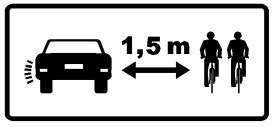
Short answer. To overtake a cyclist you must use part or all of the next lane, or the oncoming lane, and keep at least 1.5 metres of lateral clearance. If the road has more than one lane in your direction, you must change lane completely. Outside built-up areas you must also drive at least 20 km/h below the limit of the road, before you start and all through the manoeuvre. It is in article 85.4 of the Reglamento General de Circulación, in the wording of Royal Decree 518/2026, in force since 1 October 2026. Anything written about this rule before that date will not mention the 20 km/h part.
What the rule asks, point by point
| Duty | In practice |
|---|---|
| Special care | Avoid any danger to the cyclist, and treat a group as one unit |
| 1.5 metres sideways | Measured between your vehicle and the cyclist, not a guess from your mirror |
| Use the next lane | You may take part or all of the adjacent or oncoming lane; with two lanes your way, change lane fully |
| 20 km/h below the limit outside towns | From before the manoeuvre starts until it ends |
The same paragraph covers pedestrians, animals, animal-drawn vehicles, mopeds and personal mobility vehicles. It states that a group of cyclists counts as a single moving unit, so you overtake the whole group in one manoeuvre. Overtaking in a way that endangers or hinders oncoming traffic is forbidden, even when that traffic is on the shoulder. The Ley de Tráfico (art. 35.4) also sets the 1.5 metres for overtaking cycles and mopeds.
Two worked examples
A road with a limit of 90 km/h and two lanes in your direction. A cyclist rides at the right edge of the right-hand lane.
- You are outside a built-up area, so the speed rule applies: while overtaking you may not exceed 70 km/h (90 minus 20).
- Because there is more than one lane per direction, you must move completely into the left lane. Staying in your lane and squeezing past is not an option.
- You go past with at least 1.5 metres between you and the bike, and return to your lane gradually once clear.
A town street with a limit of 50 km/h and one lane each way. Here the 20 km/h reduction does not apply, because the rule is for overtaking outside built-up areas. The 1.5 metres and the need for special care still do. With a single lane per direction you can only pass by using the oncoming lane, which means you wait until it is clear. If it is not, you stay behind.
The trap. The 1.5 metres are kept from the cyclist, and for a group from the rider nearest to you, not from the lane line. The text does not distinguish between a cyclist on the shoulder and one on the carriageway: the clearance and the lane change are required either way. And the 20 km/h reduction is new, so notes and videos from before October 2026 do not have it.
When you may overtake where overtaking is banned
Where overtaking is prohibited and a cyclist is ahead, article 88.2 lets you pass, even if you must use part of the opposite lane, as long as the cyclist's speed allows it without risk to the cyclist or to traffic in general. The general rules of overtaking are in the Spanish page on adelantamiento.
Other duties around cyclists
- Do not overtake at junctions with cycle lanes or near them, nor near marked pedestrian crossings or level crossings (art. 87.1.b, wording of RD 518/2026).
- Turning. A cyclist has priority over a motor vehicle that turns right or left to enter another road when a cyclist is nearby (art. 64.2.b).
If you break the rule
Overtaking in a way that endangers or hinders cyclists, or without leaving 1.5 metres, costs 6 points (Ley de Tráfico, annex II, item 12). Breaking the overtaking rules is also a serious offence with a 200 euro fine (arts. 76.c and 80.1).
Keep going
- The topic in the syllabus: overtaking.
- The matching signs, in Spanish: S-891 lateral distance and P-22b cyclists.
- Related rules: speed limits in Spain and priority at junctions.
- Practise: today's free 30-question DGT exam, available in English.
Reviewed against the consolidated BOE text on 11 October 2026. DrivingLingo is independent and is not endorsed by the DGT. This page is not legal advice.