How to give way to emergency vehicles in Spain
Reviewed on 12 October 2026 · sources: BOE (Reglamento General de Circulación, articles 32 and 67–70)
Make room according to the road and the traffic around you. When you notice the special signals announcing an approaching priority vehicle, you must take appropriate action to facilitate its passage. That normally means moving right or stopping if necessary; in the motorway congestion circumstances covered by article 32, it means forming an emergency corridor. This is the current rule in RGC article 69.
The Spanish legal term vehículo prioritario means a vehicle with priority under the emergency-service rules. It does not describe every vehicle with a flashing light or every ambulance journey. Keep two questions separate: whether the approaching vehicle qualifies, and what your own position on the road requires you to do.
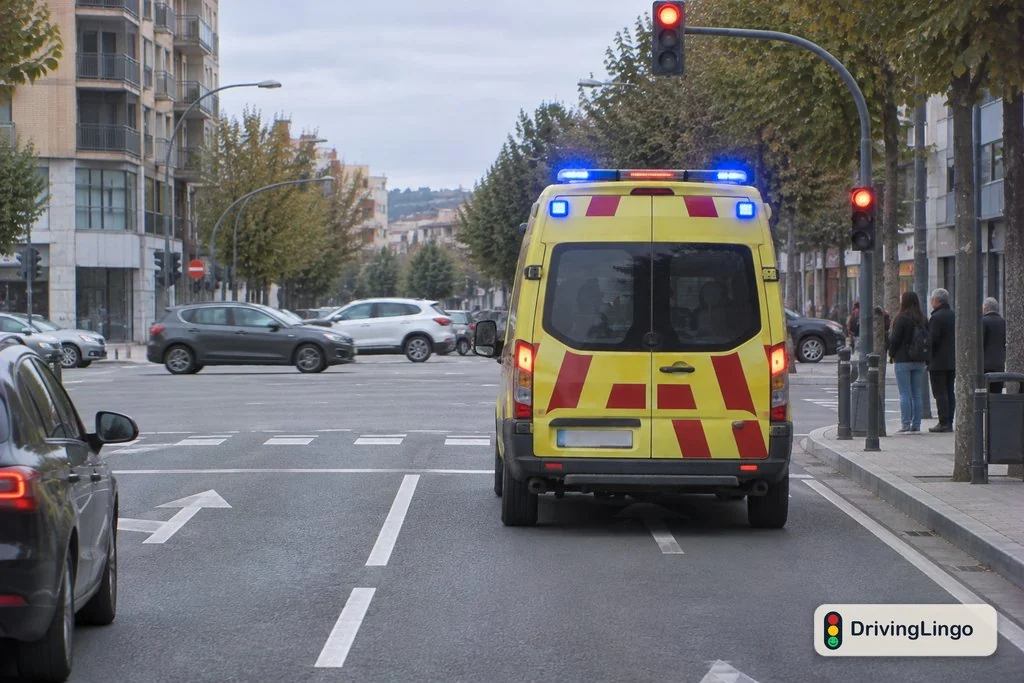
Which vehicles qualify?
Article 68.2 covers police, firefighting, civil protection and rescue, and public or private medical-assistance vehicles travelling on urgent service. Their drivers normally announce their presence using the special light and audible signals together.
There is a specific exception to the sound requirement. The driver must use the light alone when omitting the siren creates no danger for other road users. Consequently, “no siren means no priority” is an unreliable shortcut. The urgent service and the legal signalling conditions matter together.
For a learner arriving from another country, it is useful to translate ceder el paso as give way. That is an obligation to allow passage, not an instruction to perform the same steering movement in every situation.
On an ordinary road: make space without inventing privileges
Suppose an emergency vehicle approaches from behind while you are driving along a town street. Under article 69, your response must fit the circumstances: normally move right, and stop if necessary. The word “normally” matters. It avoids turning the instruction into an automatic manoeuvre regardless of surrounding traffic or obstacles.
Giving way does not transfer the emergency driver's special legal powers to your car. Article 68.1 assigns those powers to drivers of priority vehicles under specified safety conditions. If you are waiting at a red light, the obligation to help an ambulance through is not itself permission to drive past that light. A traffic officer's instructions are a separate matter; they remain binding, including for the emergency driver.
In motorway congestion: form the corridor in the right place
Article 32.1 applies on motorways and dual carriageways when congestion causes vehicles to stop or travel at walking pace. Vehicles must position themselves to leave space for approaching priority vehicles.
| Lanes in your direction | Location of the emergency corridor |
|---|---|
| Two | Between the two lanes |
| Three or more | Between the leftmost lane and the lane immediately beside it |
On roads with three or more lanes, vehicles in the leftmost lane move as far left as possible. Vehicles in all the other lanes move as far right as possible. An emergency corridor is therefore not another name for the shoulder. Its location depends on the lanes described in article 32.
Consider a four-lane motorway queue. You are in the second lane from the left. It may feel natural to move left because you are near that side of the road, but the rule places your lane with the other lanes moving right. The corridor runs between you and the leftmost lane. This is the detail worth rehearsing mentally before encountering congestion.
Article 32.2 addresses a different situation: snow making motorway or dual-carriageway travel difficult. Overtaking is prohibited and traffic must use the rightmost lane, with the adjacent lane also available on sections with at least three lanes per direction. The remaining lanes to the left must be kept clear for emergency vehicles and snowploughs. Do not confuse that snow arrangement with the congestion corridor.
When a police car is telling you to stop
A police vehicle behind you may display an additional forward-facing flashing red light, alongside the signals described in article 68.2. Article 69 then requires a careful stop on the right, ahead of the police vehicle, somewhere that does not create greater risk or inconvenience. Remain inside and follow the officer's clearly communicated instructions.
That is a personal stop instruction, rather than merely a request to let the police vehicle pass. Reading the additional signal changes the action required.
Emergency powers still have limits
Under article 67.2, emergency drivers must take exceptional care before disregarding junction priority or traffic lights, establishing that pedestrians are not at risk and other drivers have stopped or are preparing to give way. Article 68.1 also keeps officers' orders binding.
A private car carrying out an unavoidable emergency journey in especially serious circumstances does not gain those powers. Article 70 describes warning other users, but still requires compliance with traffic rules, especially at junctions.
Study the priority chapter, then compare traffic-signal priority. Practise with today's free daily exam in English.
Checked against the current BOE provisions on 12 October 2026. DrivingLingo is independent and is not endorsed by the DGT.