Traffic signal priority in Spain: officers, lights, signs and markings
Reviewed on 12 October 2026 · sources: BOE (Reglamento General de Circulación, articles 59 and 133 and annex I section 4)
When two traffic instructions conflict, use the legal order of precedence. RGC article 133 places traffic officers' instructions first, followed by temporary controls and delineation devices, traffic lights, upright signs and finally road markings. If conflicting instructions come from signs of the same type, the more restrictive instruction prevails.
For English-speaking learners, priority can refer to two different questions: who gives way at a junction, and which traffic instruction takes precedence. This page covers the second. Knowing that lights rank above upright signs does not finish the decision: you must also read what the particular light actually means.
The five levels of control
| Order | Control in article 133 | What to identify |
|---|---|---|
| First | Instructions and signals of officers responsible for traffic supervision, acting within their duties | The officer's actual instruction |
| Second | Temporary signing and delineation that changes normal road use, delimiting devices and delineation signals | The arrangement currently controlling the road |
| Third | Traffic lights | The lamp, arrow and lane or movement it applies to |
| Fourth | Upright traffic signs | The sign and any qualification applying to it |
| Fifth | Road markings | The line, arrow or painted instruction applying to your lane |
The table summarises article 133.1. It is an order for resolving conflicting instructions, not permission to disregard everything below the highest signal you can see. Two controls may address different movements or work together without contradicting each other.
An officer tells you to stop at a green light
Suppose a traffic officer clearly directs your approaching vehicle to stop while the ordinary circular traffic light is green. The instruction from the officer takes precedence under article 133. You stop as directed. Memorising only “green means go” would omit the controlling fact in the scene.
The same principle helps when an officer directs traffic through a junction whose lights would otherwise prevent the movement. The officer's applicable instruction leads. Do not substitute the actions of the car in front for that instruction: first establish which movement and which road users the officer is directing.
Flashing amber and a stop sign are compatible
A flashing amber light requires exceptional caution and giving way where appropriate. It expressly does not remove the obligation to obey another sign requiring a stop. This meaning is in annex I, section 4.2(d).
Imagine arriving at a junction with flashing amber and an upright stop sign facing your approach. The fact that lights rank above upright signs does not erase the stop requirement: the meaning of flashing amber preserves it. Stop as the sign requires and assess the priority situation before proceeding.
A steady amber light is different. Under section 4.2(c), it requires stopping under the same conditions as a steady red, unless the vehicle is already so close when amber appears that it cannot stop before the light with sufficient safety. That is a condition tied to the moment the light changes, rather than general permission to continue through amber.
Green does not allow blocking a junction
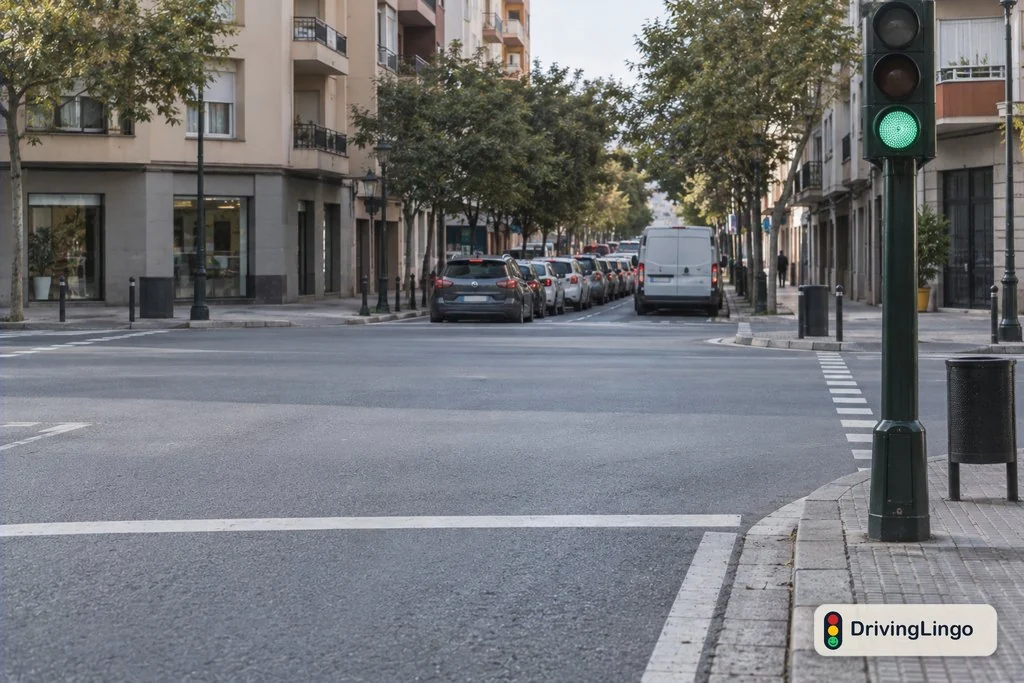
A steady circular green light permits passage with priority, subject to article 59.1. Even with priority, a driver must not enter a junction or pedestrian or cycle crossing if traffic conditions make it foreseeable that the vehicle will stop there and obstruct crossing traffic.
For example, the light turns green but a queue fills the road beyond the junction. If entering would leave your vehicle blocking the crossing movement, wait outside. There is no need for another red signal to create this restriction. It follows from the rule attached to the situation, which annex I section 4.2(e) expressly preserves.
A green arrow can answer a different question
A green arrow on a circular black background permits travel in its indicated direction despite another light showing alongside it. Drivers following it must proceed carefully, let traffic in the lane they are joining pass, and avoid endangering any road user crossing the carriageway. See annex I section 4.2(g). Permission to take the indicated turn does not give an unrestricted right to enter the receiving lane.
An overhead green downward arrow is a lane-availability signal. Section 4.3(b) says it permits using that lane, but does not remove a circular red-light requirement, another sign or marking requiring stopping or giving way, or the ordinary priority rules where no such control exists. This is an express qualification to the usual hierarchy. “Green arrow” alone is therefore too vague: identify whether it directs a turn or opens a lane.
Study trap: apply the hierarchy only after identifying the signal's scope and meaning. Flashing amber, a circular green arrow and an overhead lane arrow each carry qualifications that a simple colour mnemonic misses.
Read the traffic-lights chapter, compare the stop sign with give way, or study priority at junctions. Practise with today's free daily exam in English.
Checked against the current BOE provisions on 12 October 2026. DrivingLingo is independent and is not endorsed by the DGT.