Following distance in Spain: stopping space, overtaking gaps and tunnels
Reviewed on 12 October 2026 · sources: BOE (Reglamento General de Circulación, articles 45, 54 and 95)
Spain does not give every passenger car one fixed following distance for every road. The general rule requires enough empty space to stop without hitting the vehicle ahead if it brakes suddenly, taking particular account of speed, grip and braking conditions. A separate rule protects space for overtaking, and tunnels have their own minimum gaps. Read those as three different checks. RGC articles 54 and 95.6.
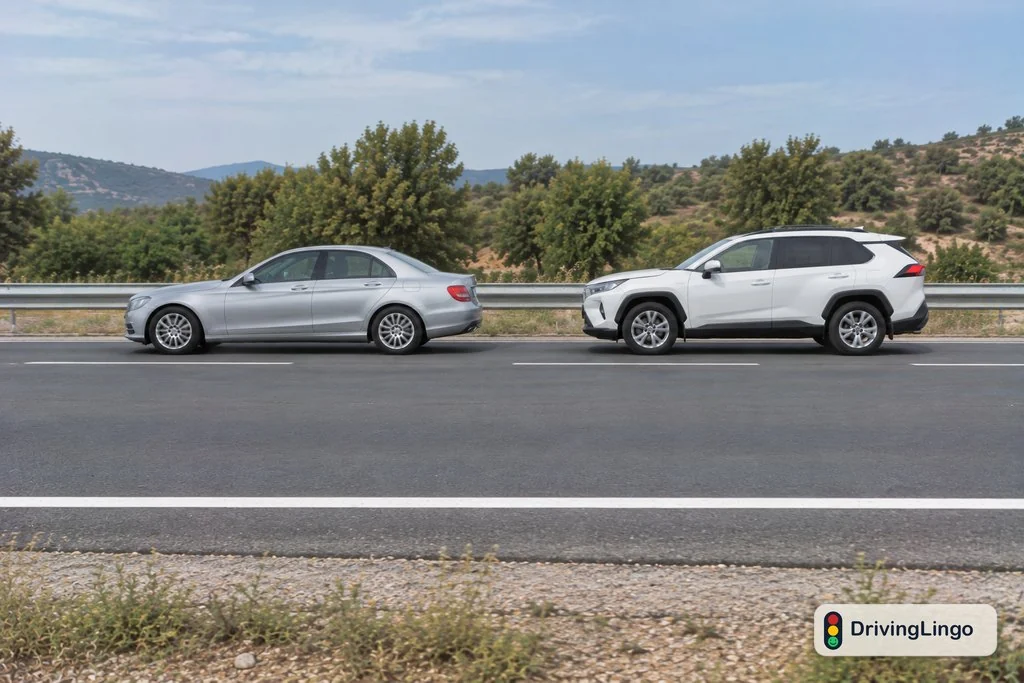
The first check: could you stop if the vehicle ahead brakes?
Article 54.1 is about the space between your vehicle and the one in front. It does not say that matching the speed limit proves that the gap is sufficient. Nor does it assign every driver an identical number of metres. Speed, grip and braking conditions are part of the assessment expressly required by the article.
For example, picture a familiar commute after rain. The posted limit may look exactly as it did yesterday, but you must assess the following space using the conditions now. Your study task is to identify what changed in the scenario, rather than retrieve one memorised distance and apply it everywhere. The separate duty to adapt speed to the road, weather, traffic, vehicle and driver, so that you can stop within the visible distance and before an obstacle, is in article 45.
A useful learning habit is to describe the gap in a full sentence: “There must be enough room to stop if the vehicle ahead brakes suddenly.” That keeps the purpose attached to the rule. It is study advice, not a numerical formula supplied by the regulation.
The second check: room for someone else to overtake
Article 54.2 adds a different requirement when following without signalling an intention to overtake: leave a separation that allows a driver behind to overtake safely. For vehicles with a maximum authorised mass over 3,500 kg, and vehicles or vehicle combinations over 10 metres in total length, that paragraph specifies at least 50 metres for this purpose. Notice both “over” boundaries. RGC article 54.2.
This provision is not a general instruction that a passenger car should always follow at 50 metres. It also does not mean that a heavy vehicle with a 50-metre gap has automatically met every safety requirement. The collision-avoidance duty in paragraph 1 still needs to be satisfied.
The additional overtaking-gap provision does not apply in a built-up area, where overtaking is prohibited, where more than one lane serves the same direction, or when traffic is so congested that overtaking is impossible. Those are exceptions to paragraph 2, not exceptions to the basic obligation to avoid a rear-end collision. Article 54.3.
A longer vehicle on two different roads
Imagine a vehicle combination longer than ten metres following another vehicle on a conventional road with one lane in each direction. It is not preparing to overtake, overtaking is permitted and traffic is flowing. In that setting, the 50-metre provision applies alongside the general safe-gap rule.
Now place the same combination on a carriageway with two lanes for its direction. The multi-lane exception removes the extra paragraph 2 requirement, but it does not remove paragraph 1. The legal change comes from the road layout, not from the driver's confidence or familiarity with the route. Both parts of this example apply article 54.1–3.
The third check: a tunnel or underpass
When not intending to overtake in a tunnel or underpass, maintain at least 100 metres or a minimum four-second interval. For vehicles whose maximum authorised mass is over 3,500 kg, the figures are 150 metres or six seconds. The provision uses “or”; do not rewrite it as if both measurements were separate cumulative thresholds. RGC article 95.6.
These figures have a particular location and context. They are not the source of a universal four-second rule on every Spanish road. Likewise, the paragraph 2 exceptions in article 54 do not cancel the tunnel requirement: they belong to a different provision.
How to organise revision
Draw three columns in your notes: ordinary safe following space, an overtaking gap for a vehicle behind, and a tunnel or underpass. Add the conditions before adding any figures. Then change one detail at a time in a made-up journey: road layout, vehicle length, maximum authorised mass or location. This is an original revision exercise, not a practice-test question or an exam answer.
Continue with speed and distance in the syllabus, the R-300 and S-5 sign entries, and overtaking in Spain. Practise in English with the free daily exam.
Source check: 12 October 2026, current BOE articles 45, 54 and 95. DrivingLingo is independent and is not endorsed by the DGT.