Overtaking in Spain: decide whether the whole manoeuvre is safe
Reviewed on 12 October 2026 · sources: BOE (Reglamento General de Circulación, articles 45 and 82–88)
Normally overtake on the left, and check that you can complete the entire manoeuvre safely before starting. That means room ahead, sufficient visibility, a safe return space and checks on vehicles both in front and behind. A gap beside the vehicle ahead is only one part of the decision. The general side rule comes from RGC article 82, and the pre-manoeuvre duties from article 84.
This page focuses on passing moving traffic and recognising prohibited locations. The separate guide to overtaking cyclists covers the additional rules for those road users.
Before moving out: look beyond the nearest car
For an overtake requiring lateral movement, signal in sufficient time and establish that there is enough clear space in the intended lane without endangering or obstructing opposing traffic. Check whether the driver ahead has signalled a move to the same side, and whether a driver behind has already begun to overtake you. You must also have room to return to your lane when finished. RGC article 84.1–3.
Imagine following a van towards a straight section. You see space beside the van but cannot see beyond it. There is no need to turn this into a calculation of how quickly your car accelerates: the missing information is the road ahead and the return space. Starting because another driver has started is especially unreliable. Article 87.1.a expressly prohibits following an overtaking vehicle into the manoeuvre when its size prevents you seeing the road ahead. RGC article 87.1.a.
While passing and when returning
The overtaking vehicle must travel at a clearly higher speed than the vehicle being passed and leave sufficient lateral space. That does not authorise breaking the speed limit: the general duty to observe speed limits remains in article 45. If circumstances make safe completion difficult after starting, reduce speed promptly, return to your lane and signal to those behind. Once the pass is complete, return as soon as possible, gradually and with signalling, without making another road user change speed or course. RGC article 85.1–3 and article 45.
For revision, divide the manoeuvre into preparation, passing and returning. A scenario that describes only the first stage is incomplete. In particular, “I can get alongside” and “I can finish without forcing anyone to react” are different judgments.
Where overtaking is prohibited
The current article 87.1.b prohibits overtaking at marked pedestrian crossings, junctions with cycle routes and level crossings, and in their proximity. Do not import an old low-speed pedestrian-crossing exception into this wording: the applicable version took effect on 1 October 2026. RGC article 87.1.b.
Restricted-visibility bends, crests and other places with insufficient visibility are covered by article 87.1.a. Its exception requires the two directions to be clearly separated and the manoeuvre to remain outside the area reserved for opposing traffic. In tunnels, underpasses and stretches covered by the tunnel sign, overtaking is prohibited when only one lane is available for your direction. Article 87.1.a and d.
Junctions and their proximity have a prohibition with specified exceptions: roundabouts, the right-side cases in article 82.2, a carriageway with expressly signed priority at the junction, and overtaking two-wheel vehicles. An exception to that location restriction does not remove the other safety duties. Article 87.1.c.
When passing on the right can be permitted
Article 82.2 addresses a vehicle clearly indicating a left turn or a stop on the left, and centrally running trams on two-way roads: pass on the right only with sufficient space and maximum precautions. In built-up areas, right-side overtaking is also permitted on carriageways with at least two marked lanes for the same direction, after ensuring it is safe for other users. RGC article 82.2–3.
Dense parallel queues are a separate situation. Where traffic fills the carriageway and each lane's speed depends on the vehicle ahead, one lane progressing faster is not treated as overtaking. In that situation, changing lanes to get ahead is prohibited; lane changes are limited to preparing a turn, leaving the carriageway or taking a particular direction. RGC article 83.2.
If another driver is overtaking you
Do not accelerate or manoeuvre to obstruct the overtake. Article 86 also requires reducing speed when danger develops, but preserves an important qualification: if the overtaker clearly abandons the manoeuvre by slowing down, you need not slow if doing so would endanger traffic; you must still help them return to their lane. RGC article 86.2.
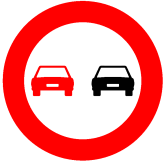
Read the wider overtaking topic, inspect R-305 and R-502, and connect the manoeuvre with following distance. Practise in English with the free daily exam.
Source check: 12 October 2026, latest applicable BOE blocks. DrivingLingo is independent and is not endorsed by the DGT.