Which lane to use in Spain, and when a shoulder is available
Reviewed on 12 October 2026 · sources: BOE (Reglamento General de Circulación, articles 30, 31, 33, 36 and 74; Ley de Tráfico, annex I)
Outside built-up areas, normally use the right-hand lane. Where more than one lane serves your direction, other lanes may be used when traffic or road conditions make that appropriate, provided you do not obstruct a vehicle following you. The shoulder is not an extra lane for ordinary passenger-car travel. These are the starting rules in RGC article 31.1.
The useful question is not simply whether a road “looks like a main road”. Identify whether you are inside a built-up area, how many lanes serve your direction, whether the road is a motorway or dual carriageway, and whether the strip beside you is a lane or a shoulder.
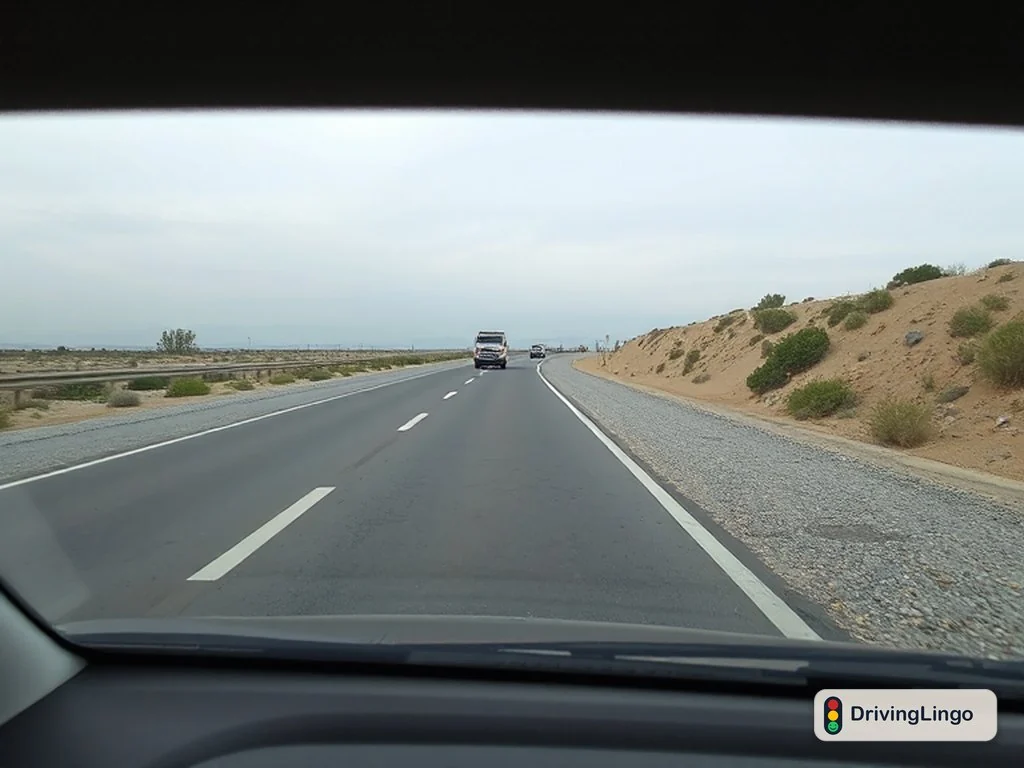
Carriageway, lane and shoulder are different terms
The carriageway is the part of the road used by vehicles and consists of lanes. A lane can exist with or without longitudinal road markings. The shoulder is the surfaced strip alongside the carriageway, intended for automobile use only in exceptional circumstances. These definitions are in Ley de Tráfico, annex I, concepts 55, 56 and 61.
In English study material, keep lane for the traffic lane and shoulder for the adjacent strip. If you learned to drive elsewhere, avoid attaching a familiar local permission to the Spanish word. A strip being wide enough for a car does not establish permission to use it as another traffic lane.
Outside a town: normally right, with conditions for moving out
On a two-way carriageway with two lanes, a passenger car uses the lane on its right. Where a two-way carriageway has three lanes separated by broken longitudinal markings, use the right-hand lane; the centre lane is only for the necessary overtaking manoeuvres or turning left, and the far-left lane must not be used. RGC article 30.1.
On a road outside a built-up area with several lanes for your direction, article 31 gives the “normally right” rule. It does not turn the centre lane into a permanent choice for a passenger car merely because the driver likes the view from it. Apply the stated traffic or road justification and the condition concerning vehicles behind. Article 31.1.
There is a further restriction on carriageways with three or more lanes in the same direction. Lorries and vans over 3,500 kg maximum authorised mass, special vehicles not required to use the shoulder, and vehicle combinations longer than seven metres normally use the rightmost lane and may use the immediately adjacent lane under the same conditions. That seven-metre threshold belongs to this lane rule; do not confuse it with the ten-metre threshold in the following-distance rule. Article 31.2.
In town: the destination rule has a precise scope
On an urban carriageway with at least two marked lanes for the same direction, an automobile driver may use the lane that best suits the destination, without obstructing others. The driver must not leave it except to prepare to change direction, overtake, stop or park. Motorways and dual carriageways are excluded from this particular rule, even inside a built-up area. RGC article 33.
Picture a city avenue where you need a later left turn. Compare that with an urban motorway passing through the same city. “Both are in town” is not enough to apply the destination-lane rule to both. The road category and marked-lane conditions decide its scope. Planning the route before the junction helps you read these details without making a rushed change.
Whenever a lateral movement changes lanes, respect the priority of vehicles already travelling in the lane you intend to occupy. A destination choice does not override that duty. RGC article 74.2.
A shoulder is not a queue shortcut
Article 36.1 requires specified users, including cycles and mopeds, to use a usable, sufficiently wide right-hand shoulder when no dedicated route or part of the road exists for them; otherwise they use the necessary part of the carriageway. It also covers vehicles up to 3,500 kg moving abnormally slowly because of an emergency and thereby seriously disrupting traffic. That emergency condition matters: ordinary congestion is not a general passenger-car entitlement to drive along the shoulder. RGC article 36.1.
The current motorcycle exception is narrower than “motorcycles can use shoulders in queues”. It concerns specially authorised and signed stretches, applies only while lane traffic is stationary because of congestion, limits speed to 30 km/h and requires single-file travel with particular care. Riders must avoid endangering users required to use the shoulder and leave it if necessary. Article 36.3, effective 1 October 2026.
For further study, use the lanes and shoulders topic, compare the S-1 and S-1a sign entries, and read stopping and parking. Practise in English with the free daily exam.
Source check: 12 October 2026, latest applicable BOE blocks, including the October versions of articles 31 and 36. DrivingLingo is independent and is not endorsed by the DGT.