Seat belt rules in Spain: who must buckle up?
Reviewed on 12 October 2026 · sources: BOE (Reglamento General de Circulación, articles 117 and 119)
The ordinary rule is the same in the front and the back: drivers and occupants must use the approved seat belts fitted to their vehicle, correctly fastened, on urban and interurban roads. RGC article 117.1 sets that obligation. A short journey through town is not an exemption. Neither is being an adult passenger in the rear seat.
For an English-speaking learner, seat belt and safety belt describe the same equipment. In Spanish the term is cinturón de seguridad. The useful distinction is between the ordinary duty to wear it and an exemption that applies to a particular person or manoeuvre. Being in an exempt category for one part of a journey does not make the whole journey exempt.
A local journey is still a journey
Imagine three adults leaving a restaurant in a car with working belts. The driver and front passenger buckle up, while the rear passenger says the hotel is only a few streets away. Article 117.1 still applies to all three. It does not set a minimum distance, speed or journey duration before the belt requirement begins.
The same provision covers urban and interurban travel. You therefore do not need to decide whether a particular stretch counts as a town street before applying the ordinary belt rule. For this scenario, the relevant facts are that the person is an occupant, a belt is installed, and no applicable exemption has been identified. A rear seat does not create an exception.
Article 117.1 does say that the belt-use obligation is not enforceable in vehicles without belts installed. That is a limit to this particular use requirement, rather than permission to remove equipment. This guide does not determine which vehicles must have belts installed; that is a separate vehicle-equipment question.
Reversing and parking: an exemption for the driver
Article 119.1(a) exempts drivers while carrying out a reversing or parking manoeuvre. The scope matters: the provision identifies the driver, rather than everybody in the vehicle, and the manoeuvre, rather than the whole trip to a parking space.
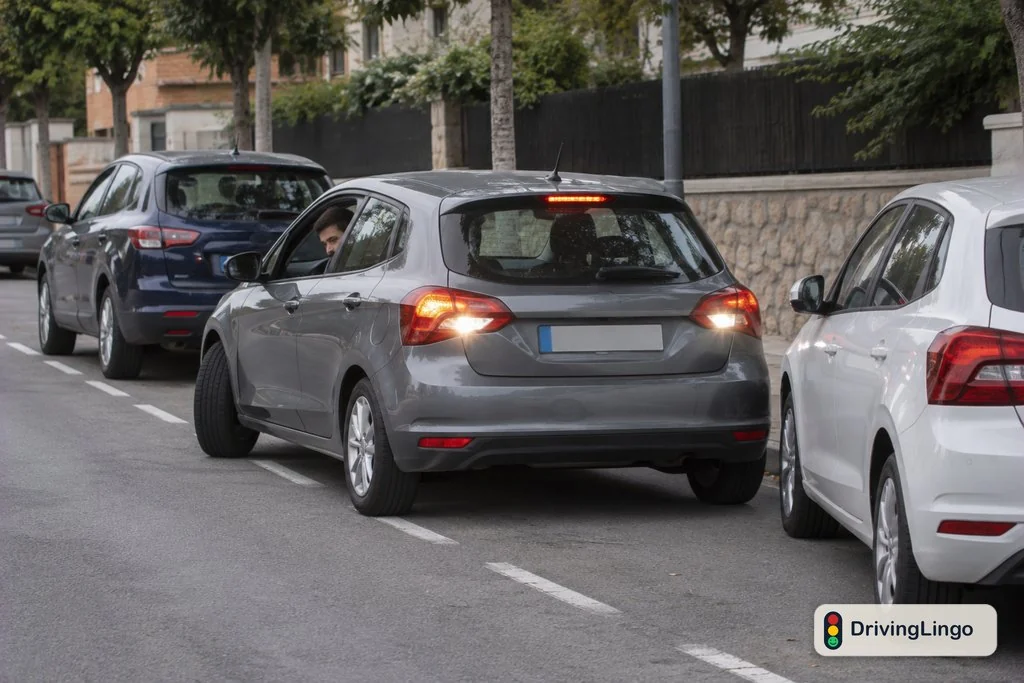
For example, a driver completes a parking manoeuvre and then starts an ordinary forward journey along the street. The manoeuvre exemption no longer describes what the driver is doing. The general requirement resumes. Meanwhile, an adult passenger cannot use the driver's reversing exemption as their own reason to unfasten a belt.
This is a useful way to read exceptions throughout the driving syllabus: underline the person named, the activity described and any geographical limit. All three can change the outcome even when the equipment is identical.
Medical exemptions require the specified certificate
The other exemption in article 119.1(b) concerns people holding an exemption certificate for serious medical reasons or disability. The certificate must be shown when a traffic officer requests it. A certificate of this kind issued by the competent authority of an EU member state is valid in Spain when accompanied by its official translation.
Discomfort alone is not the certificate described by the provision. Nor does the current text give pregnancy its own automatic exemption. Someone travelling with a foreign medical document should distinguish an ordinary medical letter from the exemption certificate and translation required by this rule. This page explains the legal documentation condition; it does not assess an individual's medical suitability to wear a belt.
Taxi passengers and emergency-service exceptions
An adult taxi passenger remains within the ordinary belt rule. The current article 119.2 has a specific child-restraint provision for taxis in urban traffic or urban areas of large cities: a person under 135 cm may travel without the specified approved restraint if seated in the rear. That provision is not an exemption for an adult taxi passenger. The separate children-in-cars guide explains child seating in detail.
Article 119.2 also exempts drivers and passengers of vehicles on emergency service when travelling in built-up areas, but excludes motorways, dual carriageways and conventional roads from that general emergency-service exemption. There is a further, narrower exception on all road types for passengers in suitably equipped treatment ambulances who occupy the patient compartment to provide medical care during an emergency journey. Those are defined working circumstances, not permission for occupants of any car taking someone to hospital to travel unbelted.
Study trap: do not memorise an old list of exempt professions. Apply the current article to the actual person and journey. The ordinary passenger rule, the reversing-driver exemption and the ambulance-care exception each have different scopes.
Continue studying in English
Read the passive-safety chapter for the wider topic, or compare the separate duties around emergency vehicles. To practise, use today's free daily exam in English.
Checked against the current BOE provisions on 12 October 2026. DrivingLingo is independent and is not endorsed by the DGT.